Playing games with symbols
There are many symbolic games (languages) to be played. These games consist of symbols and operators. Some games are built from the inside out, starting with bare principles and producing interesting complexity. Other games are built from the outside in; we see complexity and try to find some set of operators.
Poetry is one such game to play. It is in the domain of natural languages where operators are not well defined. Poetry is defined by open interpretation—the same set of symbols have different meanings for different people. How do we debate interpretations with one another? I believe we look for interpretations that align with our aesthetics (what we find ourselves wanting to be true, a priori). It is just pattern-matching on your base preferences, which can also be understand as emotion because you are relying on your feelings (found in bodily sensations).
A symbolic game that is on the opposite end of the spectrum is a strict mathematical system. These systems are built with base symbols and operators, which start from just a single structure like sets. Out of sets and basic set operations we construct numbers, addition, subtraction, etc. We continue to explore complexity that emerges from these rules. All complexity is deduced through rigorous proof.
In math there is no room for interpretation, in the strict sense. Yes, you can map maths onto other domains (universe around us) in different ways. But within the closed system of maths, there is total certainty. Basically these strict formal systems reliably reproduce the same structure across minds. They are mechanical.
This seems quite satisfying to my aesthetic. The problem is that inside-out languages tell us little about the universe we care about (the ones our emotions are coupled to). This is the world of minds, people, goals, etc. What languages address these domains? Poetry: we find semantics that can seem to answer questions we do care about—many of them existential (why are we here? what is consciousness?). This is why I can appreciate Sufism.
We can plot all symbol games across two dimensions: (1) mechanical (how reproducible the game is, how well understood the operators are) and (2) scope (how meaningful the conclusions are).
Here’s how it might look:
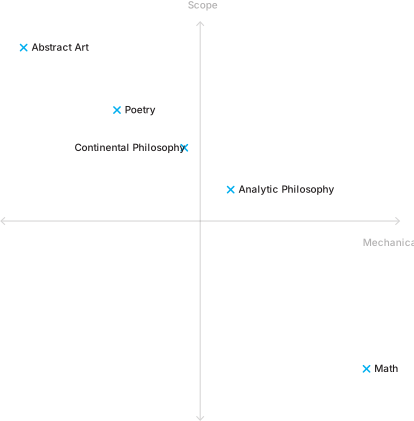
It should be clear that math can be installed on a computer. It is less clear that abstract art can. This is not to say they are not still in the class of computable functions. Generative AI models give good evidence that all language games we play are functional.
That is, I look at an LLM and see a distorted mirror. The computer can produce the same structure of meaning as that in my mind. If the mind is what the brain is doing, brains and computers are in the same class of things. This is a premise of the computational theory of mind.
Philosophy in the ancient age was interested in strict systems (think of the Greeks). Philosophy in the post-modern era looks like poetry to me. I am constantly reminded of one of Nietzche’s insights:
Every great philosophy so far has been […] the personal confession of its author and a kind of involuntary and unconscious memoir.
Most analysis bears this reality. It may be impossible to escape it.