Post-modernism is self defeating
I just read a few chapters from Poor Charlie’s Almanack. Funny enough, the first chapter is a commencement speech to Harvard Westlake’s 1986 graduating class.
There is a focus on simple ideas. Wisdom that tests the stand of time, like “be honest” or “avoid envy”. Simplicity is a good corrective for my bias towards complex mental structure. The mind’s dialectic has a tendency towards convoluted arguments. My assumptions aren’t wrong, I just haven’t made enough of them!
Many philosophers I read fall into this trap. A part of it is their prose – it is unfamiliar, so it sounds complex.1 But most of it is that we, as readers, confuse complexity with intelligence. Remember that intelligence is just the capacity for accurate prediction. Since philosophers compete for popularity in the “market of philosophers”, the ones we read often have this flaw (consciously or not). So they tell these long stories with lots of bloat. You rarely see a thinker revert to a simpler model. That would be pretty damaging to their career.
I fall victim to this complexity bias. Which arguments give rise to needless complexity and bloat in my own thinking? Its mostly shitty epistemology. How did I get there? Here’s been the progression of my “truth-finding mechanisms”:
Stage 0: no awareness. You are driven by stimulus-response mechanisms you do not see. The self is not sophisticated enough to have answers.
Stage 1: convention. The tribe has the right answers. Just imitate.
Stage 2: empiricism. Tribes create hiveminds. You have to think for yourself using falsifiable claims and appropriate tests. This is the secular, enlightenment, modern perspective.
Stage 3: nothing is objectively true. All conclusions rest on axioms, which we can’t get behind. We don’t even know how basic logical operators work. We can also’t get anything normative, like Hume said.
Note the similarity to Kegan’s 5 stages of cognitive development.
In my teenage years, I was totally reason-oriented. I felt truth was real and my job was to approximate it. There is a concrete life best lived. But after switching between so many life philosophies you see your engagement with truth as this never-ending drama. And you can grow cynical.
Then, you ask big questions: how should I define truthiness? How does language work? Why do the base logical operators work? There are no good answers from my understanding. You adopt your system of truthiness based on convention (the hivemind!).
So Stage 3 is where I’ve been for a few years now. You basically “defer to The Dao” (give into your base instinct). It coincides with a relinquishing of agency and choice. Any normative thinking is like grasping at sand. The longer you sit with it, the worse it gets. So you don’t get many new ideas, you just get circular with bad epistemology. Since behavioral change relies on new mental structure, this is a fantastic way to stay stuck. More and more I wake up to the inadequacy of Stage 3.
First, the argument is just self-defeating. If there is no objective truth, how could one make this very claim? My friend sent me Strauss’ critique of Heidegger’s historicism (the idea that all truth is historical):
To assert the historicist thesis means to doubt it and thus to transcend it … Historicism thrives on the fact that it inconsistently exempts itself from its own verdict about all human thought … The historicist thesis is self-contradictory or absurd.
How has it taken me so long to see this clearly? Close friends have told me to be skeptical of my own skepticism, but I have brushed it off. Truth isn’t always nice, sorry! This system of truthiness runs into a basic internal contradictions. And contradiction is the hallmark of bad argumentation.
Second, post-modernism is the null set of arguments. Even if we ignore the self-contradiction, the post-truth world is just trivial. Like, given there isn’t objective truth… where do you go from here? You can’t make any claims which leaves you without any structure. It’s just so uninteresting.
What might Stage 4 look like? In the same way Stage 3 parallels the naivety of Stage 1, Stage 4 may parallel the naivety of Stage 2. Being naive is not being wrong. Being naive means you have limited scope.
To formalize, let be the set of truth claims at Stage . Fool tier theory2 posits:
(Axiom 1) (adjacent stages contradict)
(Axiom 2) (next-adjacent stages agree)
This can generalize to any dialectic. It is something like a Dunning-Kruger effect? It reminds me of this all-time meme. I’m the guy in the middle, stuck in Stage 3.
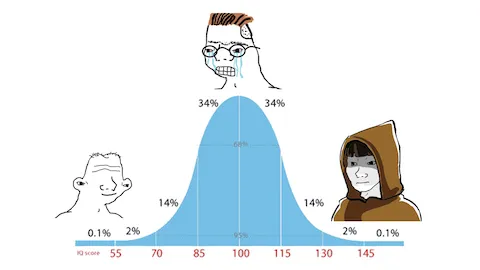
So I should decrease certainty in my thinking on abstract and meta topics and increase certainty on my common sense thinking. I need to redefine my circle of competence. Maybe this is why Munger never talks about epistemology. “All I want to know is where I’m going to die, so I’ll never go there.” Stage 3 is a sort of death.
Practical wisdom is useful. Working on your decision making is useful. Improving yourself is useful. All these serve the goals you care about. There is a place for principles.
Another point: wisdom is really about fixing biases, not finding dominant strategies. That is, wisdom is defining the good miss. Be truthful to the degree it serves you. Be forgiving to the degree it serves you. Wisdom is not about defining the telos. It is about how you get there. It should be clear that wisdom is personal, then. It fits onto your predispositions. It just so happens that we all share common flaws.
My mind has become a breeding ground for post-truth. Everything is relative, and nothing stands. I must purge these tendencies from my mind.